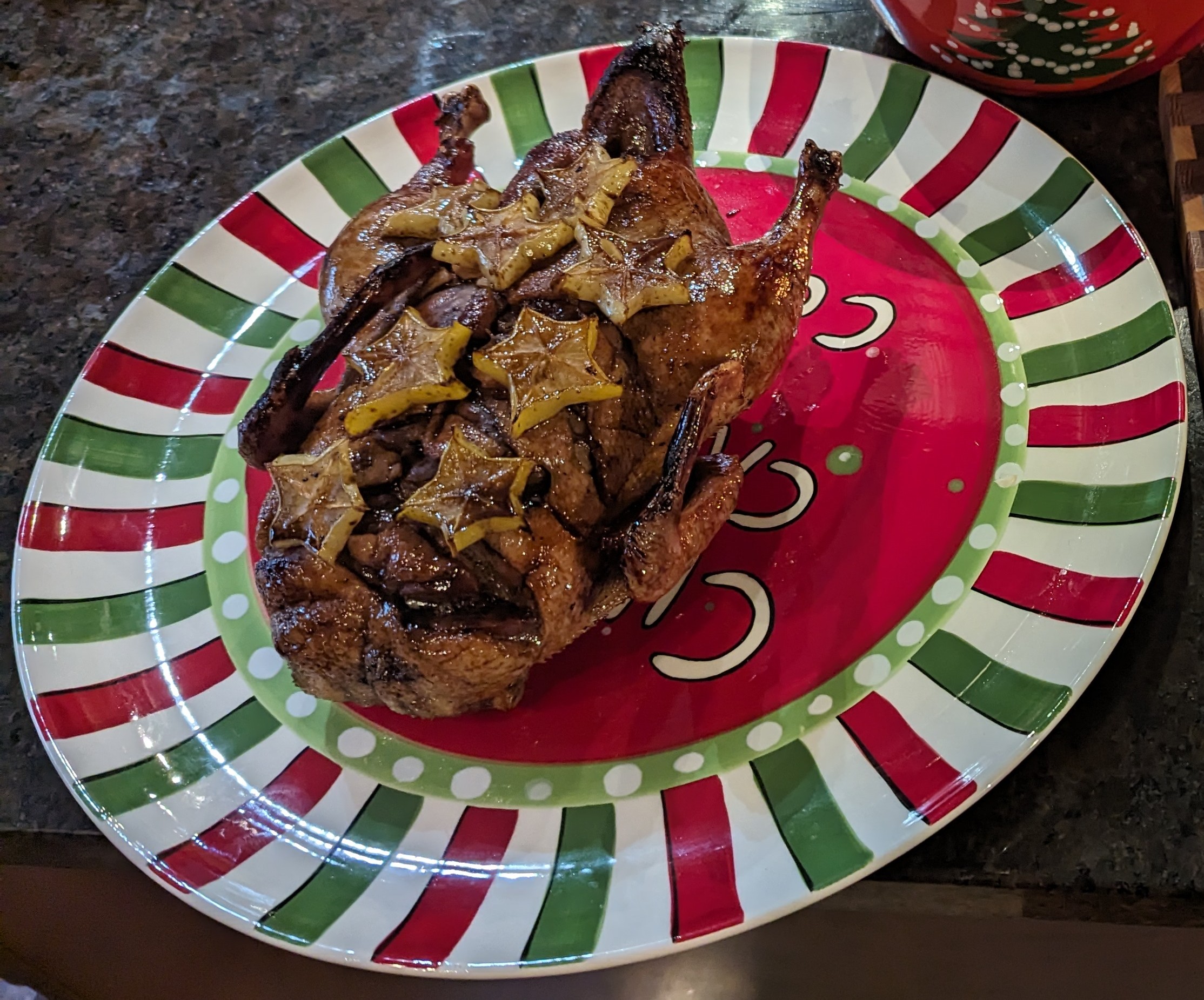
This is a great way to eat duck, during the holidays or whenever. I’ve also adapted this recipe to roast a turkey; if you do this, just be sure to scale up the other ingredients to match the size turkey you have. The original version of this recipe uses lemons instead of orange, starfruit, or pomegranates. You can find it here.
The companion recipe for brussel sprouts and squash pairs nicely. Add some mulled wine for extra holiday cheer. This recipe doesn’t call for a gravy and it was juicy enough that I don’t think it needed it, but it would be easy enough to create one with the drippings and giblets.
6 lb whole Pekin duck
salt
5 garlic cloves, chopped
1 orange or 2-3 clementines, sliced
pomegranate seeds and starfruit for stuffing and decoration (optional)
Glaze:
½ cup balsamic vinegar
1 orange, freshly squeezed juice
¼ cup honey
If you have a frozen duck, be sure to thaw it out in the fridge for a couple of days. Once it’s completely thawed (in the refrigerator), take the duck out 30 minutes before cooking to bring it more or less to room temperature.
Preheat oven to 350F. Put a rack in a large roasting pan.
Remove the giblets from inside the duck. Rinse the duck, inside and outside, with cold water. Pat dry with paper towels.
Score the skin on the breast in a diamond pattern, being sure to only cut the skin without reaching the meat. Poke the other fatty parts of the duck with the tip of the knife all over to ensure fat release, especially in very fatty parts. You don’t need to poke the duck legs as the skin is pretty thin there (except where the duck legs connect to the duck body).
Season the duck generously with salt both inside the duck’s cavity and outside on the skin, legs, and all over. Place the duck breast side up.
Put the chopped garlic cloves and orange slices (and starfruit / pomegranate seeds if you have them) inside the duck cavity. The duck will have flapping skin on both ends – fold that skin inwards, to hold the garlic and fruit inside. Tie up the duck legs with butcher’s twine.
Place the bird breast side up on the rack in the roasting pan and roast for 40 minutes, uncovered. While it’s cooking, whisk together the ingredients for the glaze.
Flip the duck on its breast and roast it breast side down for 20 more minutes, uncovered.
Check the duck’s internal temperature with an instant meat thermometer. If the temperature reaches 140F, proceed to the next step. If the meat temperature is below 140F, roast the duck for 10-20 more minutes or until the temperature reaches 140F.
If you have a very fatty duck, take it out of the oven at this point and use a baster to remove some of the extra fat juices from the pan. This is an optional step, as those juices can still be useful in keeping the duck moist.
Flip the duck breast-side-up again and brush with the glaze. If you want to add starfruit on top, now is the time to do so, and brush that with the glaze as well. Put it back in the oven and roast for another hour, brushing every 10 minutes or so with the glaze.
Note about cooking time: the original recipe suggests a 3-hour cooking time but we barely needed more than 2 hours for a 5-pound duck. Keep checking the internal temperature once you start basting and stop cooking once you hit 155F in the thickest part of the meat. Then, let it sit for 10-15 minutes on the counter until it reaches 165F. This ensures the duck will be well done, delicious, and safe to eat. Check the internal temperature in the thigh’s and wing’s innermost part and the breast’s thickest part.
As an option, you can broil the duck for about 5 or 10 minutes (check it regularly to ensure it doesn’t char too much). This helps speed up the caramelization of the skin if your duck is already cooked to a desired internal temperature (as measured by a meat thermometer).
Remove the duck from the oven once the internal temperature reaches 155F (and after you’ve briefly broiled it if needed). Let it rest, uncovered, on the kitchen counter for about 15 minutes. During this time the duck will continue cooking in residual heat until it reaches 165F.
Discard the fruit from the cavity. Carve the duck and serve!
 Anne's Kitchen