
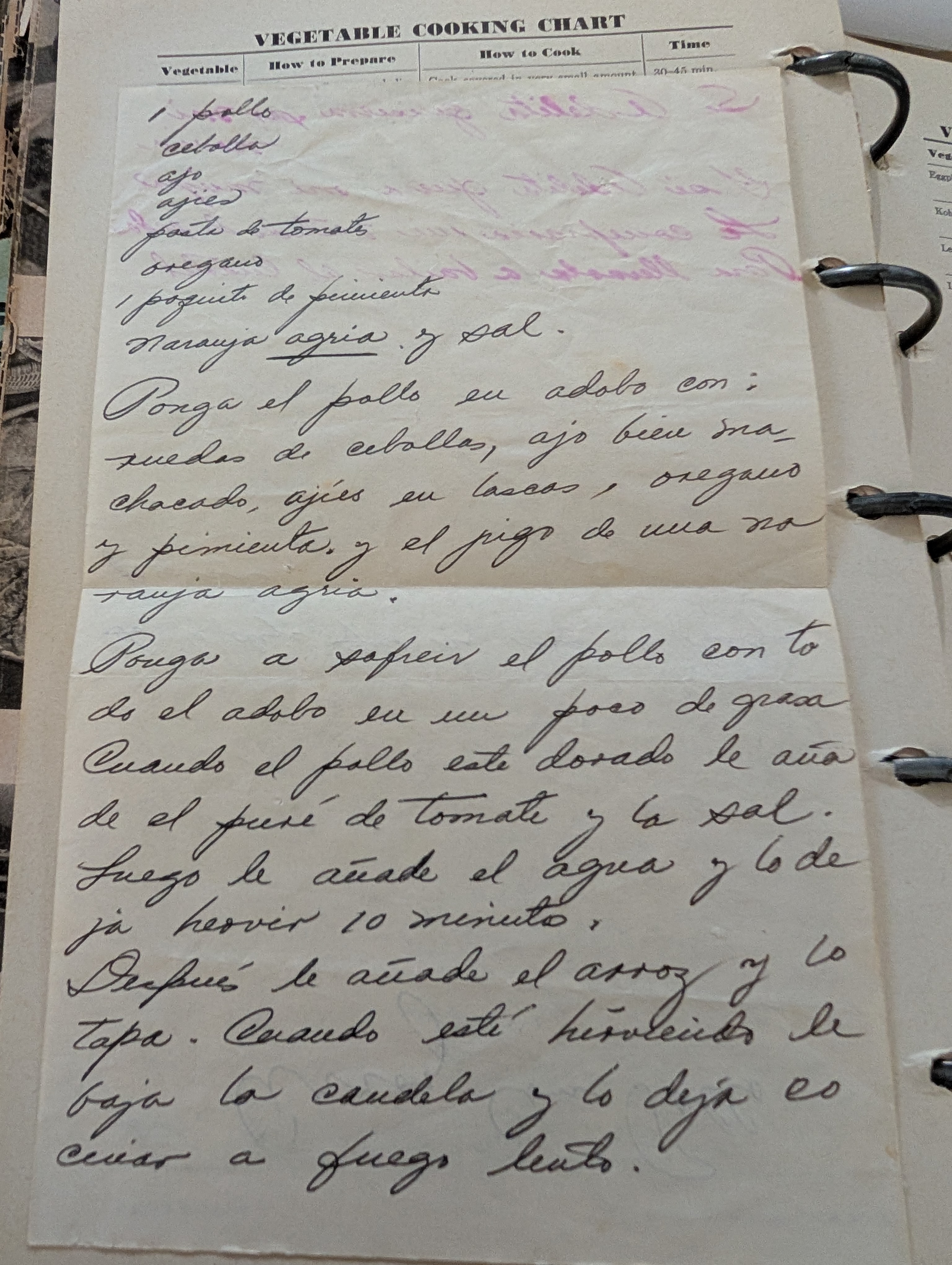
My grandmother Dorothy taught Spanish before she married, and had this handwritten recipe wedged between pages of her copy of Better Homes and Gardens. I don’t know precisely how old it is, but she got married in the 1920s and probably didn’t teach afterward (she died before I was born, so there’s a lot I still don’t know about her).
There are many variations of this dish from throughout the Spanish-speaking world. This version doesn’t appear to be specific to any one region, and my grandmother certainly didn’t say so in her notes. If anything, it’s her take on the Illinois variation (with some new elements I’ve added).
As it happens, my 3 years of learning Spanish on Duolingo wasn’t quite enough to help me decipher and make this recipe. So, I owe a BIG thank you to Marketa Prahy, Andrea Lopez-Holsey, Maggie Hurley, and Athan Chilton for helping me with the translation and filling in the blanks in the instructions! I also used a little guidance from this recipe.
2 lbs. chicken breasts and/or thighs
1 onion, sliced
4 garlic cloves, smashed
1 guajillo chili pepper (or 1 tbsp or more of chili flakes)
1/4 c. tomato paste
1 tbsp. oregano
1 c. orange juice*
Juice of 1 lime (2 tbsp.) + lime zest*
1 tbsp. + 1 tsp. salt
2-3 tbsp. olive oil, butter, or bacon grease
1 1/2 c. uncooked rice
3 c. water
1 c. peas (optional)
Black olives (optional)
pimiento peppers (for garnish)
*The original recipe called for “naranja agria,” which could be translated as sour or bitter orange. The closest I could find to this is Seville oranges, which aren’t available in my area, so I’ve added regular orange juice and lime to try to recreate the sweet/sour complexity.

Prepare the chicken in a marinade with onion, garlic, chili, 2 tbsp. of the tomato paste, orange/lime juice and zest, oregano, pepper, and 1 tsp. of the salt. Let it marinate for at least an hour, preferably more.
Heat a Dutch oven or other large pot on medium heat with the oil/butter/bacon grease. Remove the chicken from the marinade and let it brown on both sides for a few minutes each.
Add the rest of the tomato paste and salt. Add the water and rice, then bring to a boil for about 10 minutes.
Salvage the solid matter from the marinade and add it to the pot, then discard the rest.
Cover and reduce the heat to low, simmering for about 35-45 minutes. If you choose to add any peas and/or olives, now is a good time to do so.
Remove the lid and check the rice for doneness. Give it a couple more minutes uncovered if it’s still pretty wet, though a little juice is okay for this.
Add a few pimientos to serve.
 Anne's Kitchen