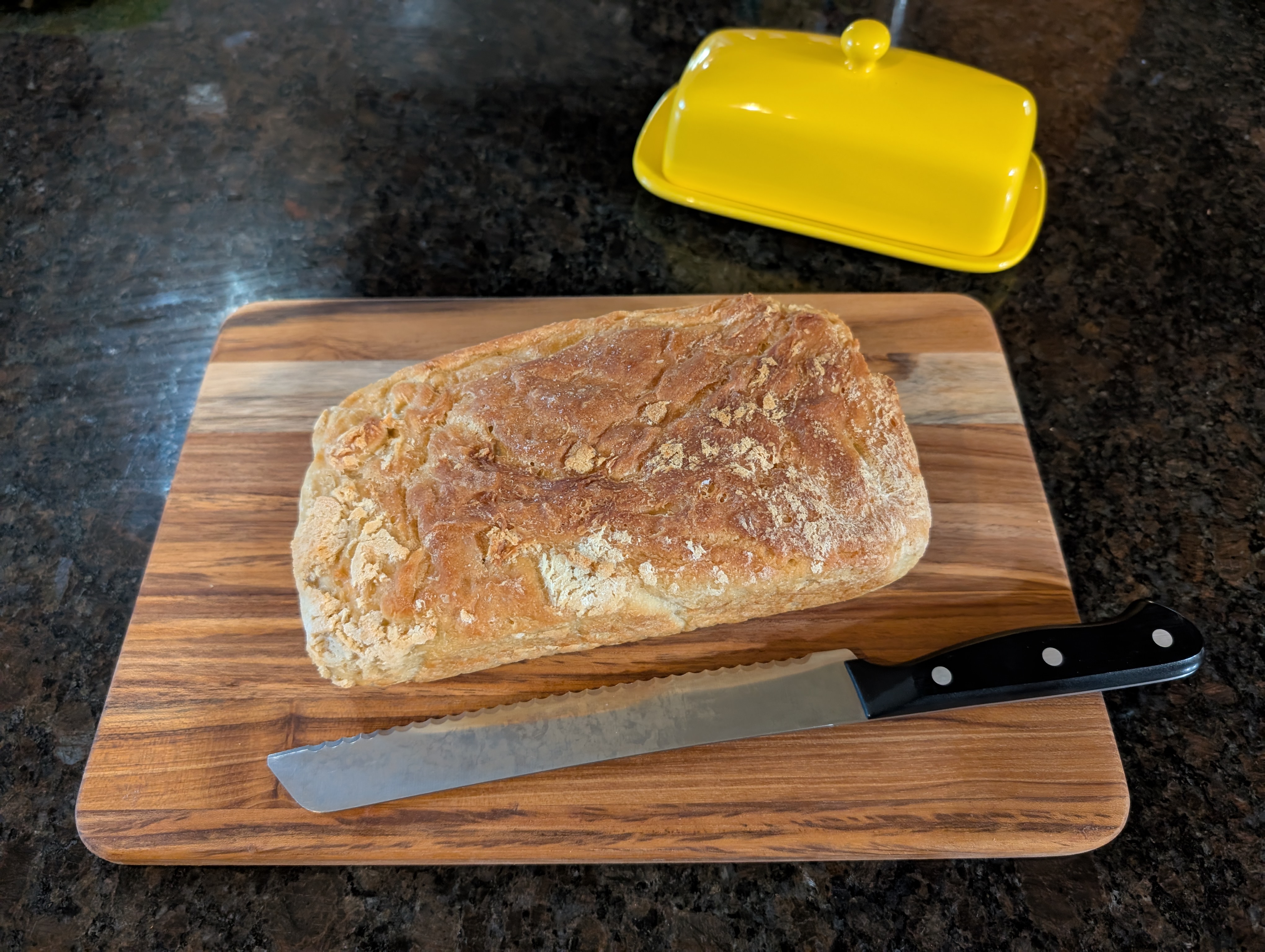
I still need to do a lot of work on my breadmaking skills. Paul Hollywood would definitely not be impressed with this batch (he might even poke his finger in the middle of a slice and give it the dreaded pronunciation of “stodgy“). I started with this recipe and have added notes based on what failed in this batch (it got too dry during proofing, according to my spouse with more experience with such things). I also had trouble working the dough, though I don’t know what to recommend for fixing that except to keep practicing at it.

toasted with almond butter and a drizzle of honey.
This makes 2 loaves.
2 c. warm water (105-115F)
1 tbsp. active dry yeast
1/4 cup honey
2 tsp. salt
2 tbsp. oil (canola or vegetable)
4-5 1/2 c. all-purpose or bread flour
In a large bowl or stand mixer (glass, not metal), add the yeast, water, and a pinch of the honey. Allow to rest for 5-10 minutes until foaming and bubbly. (This is called “proofing” the yeast, to make sure it is active. If it doesn’t foam, the yeast is no good, and you need to start over with fresh yeast).
Add remaining honey, salt, oil, and 3 cups of flour. Mix to combine.
Add another cup of flour and mix to combine. With the mixer running, add more flour, ½ cup at a time, until the dough begins to pull away from the sides of the bowl. The dough should be smooth and elastic, and slightly stick to a clean finger, but not be overly sticky. Add a little more flour, if needed.
Mix the dough for 4-5 minutes on medium speed (or knead with your hands on a lightly floured surface, for 5-8 minutes).
Grease a large glass or ceramic bowl with oil or cooking spray and place the dough inside, turning to coat. Cover with a DAMP dish towel or plastic wrap and allow to rise in a warm place until doubled in size, about 1 ½ hours. (If your oven has a proofing setting, use that.)
Spray two 9×5” bread pans generously with cooking spray on all sides.
Punch the dough down well to remove air bubbles. Divide into two equal portions. Shape each ball into long logs and place into greased loaf pans.
Cover pans with a lightweight, damp dish towel. Allow dough to rise again for about 45 minutes to one hour, or until risen about 1 inch above the loaf pans. This is the second proof. Gently remove covering.
Preheat oven to 350 F (take the pans out of the oven if it’s the same one you proofed in).
Bake bread for about 30-33 minutes, or until golden brown on top. Give the top of a loaf a gentle tap; it should sound hollow.
Invert the loaves onto a wire cooling rack. Brush the tops with butter or olive oil and allow to cool for at least 10 minutes before slicing.
Once cool, store in an airtight container or bag for 2-3 days at room temperature, or up to 5 days in the refrigerator.
 Anne's Kitchen