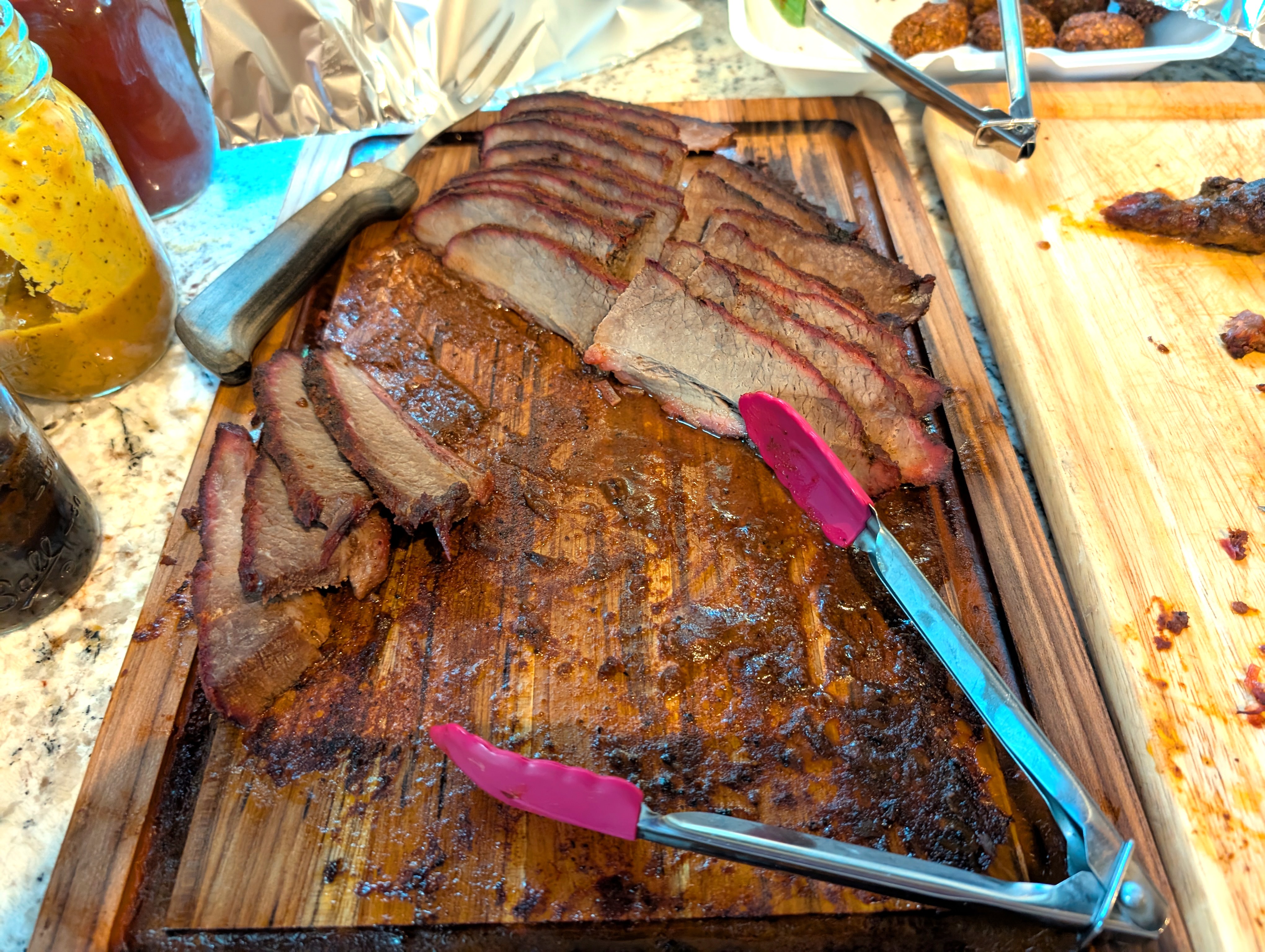
Since my spouse and I got a pellet smoker last year, I’ve been looking for recipes for things to smoke. I recently decided to try out this recipe from Traeger for a 5.5-pound brisket. Since I’m using a different brand of pellet grill, I wanted to save a version without branding references or ads, but if you want to see the original recipe and all its additional flair, feel free to follow the embedded link in this paragraph.
As it happens, smoking larger pieces of meat has a somewhat steep learning curve as there are a few more variables that need to be addressed compared to baking in an oven, and I’m not sure I’ve mastered them yet. And as much as I’d like to master them sooner rather than later, buying and smoking a brisket isn’t something I have the budget, time, or room in my stomach to attempt frequently. For now, this page will have to suffice for my first and (as yet) single attempt.
Temperature note: The biggest issue is time vs. temperature, especially if you have an outdoor smoker. The biggest takeaway from this trial is that if it’s hot outside, the meat hits the cooked temperature sooner — but if it’s a tougher cut of meat and you take it out sooner, it’s not going to have enough time to tenderize. This is the opposite problem that I had with the smoked turkey I made last Thanksgiving, when the weather was in the 30sF and I needed to cook for a couple hours longer than the recipe indicated.
The original recipe said to budget about 10-11 hours for this, including prep time, smoking, and letting it rest before eating. In this timeline, the first smoking should take about 3 hours 15 minutes, then there is some more prep work to wrap it in butcher paper before smoking for about 6 more hours. However, this recipe also says to take it out when it first hits 160-170F, then later when it hits 200-205F. But in this case, the outdoor temperature was at least 80F and the brisket hit the initial 160F in less than 2 hours instead of 3 1/4, and 200F in about 4 hours instead of 6. As a result, the meat was cooked but still very tough.
In the future, when I’m smoking in warm weather, I’m going to keep using an internal thermometer but let it continue to cook for the full target time, just in case. I have no idea if this will result in an overcooked meat, but I’m not sure how else to troubleshoot this yet. (This page might get updated if/when I do have a second chance to work on the recipe.)
Flavor note: This recipe calls for any dry rub seasoning, so you can use store-bought or make it yourself. I used this version from scratch, which worked on the smoked turkey, too. After the brisket is cooked, you can serve it with whichever barbecue sauce you prefer. I like this Whiskey Tango Fun! BBQ sauce, which is a good go-to, standard barbecue sauce.
Ingredients:
5-lb. brisket flat trimmed of fat cap and silver skin
½ cup BBQ Seasoning beef / brisket rub (maybe try this one)
¼ cup apple cider vinegar
Tools needed (less commonly found in the average kitchen/home):
pellet smoker/grill
butcher paper
meat/grill thermometer
food-safe spray bottle
While the brisket is still cold from the fridge, start by trimming the fat side of the brisket down to roughly 1/4 inch and remove the silver skin (the connective tissue that makes the meat tough and prevents seasoning from sinking in). How to trim silver skin: place the brisket fat-side down and carefully slide your knife between the meat and the gristle/fat. (There’s a helpful video demonstrating the process here.)
Leave the brisket out for 20-30 minutes ahead of smoking to help bring it to room temperature.
15 minutes before smoking, preheat the grill to 250F.
Season the brisket by massaging the seasoning into the brisket top, bottom, and sides.
Place your brisket on the pellet grill grates, fat-side up and smoke brisket flat until the internal temperature of the brisket reaches 160 – 170F, measured in the thickest part of the meat. This will take about 3 hours and 15 minutes (pending on the outdoor temperature; see note above). Remove the partially smoked brisket flat from the grill. Keep the lid to the smoker closed and the smoker on.
Add apple cider vinegar to a spray bottle and set aside. On a large work surface, roll out a piece of butcher paper roughly 5-6 times larger than your piece of beef. The inside of the butcher paper should be facing up. Spray the inside of the butcher paper (where you’re going to set the brisket down) with some apple cider vinegar, until the area that will touch the brisket flat once it’s wrapped is fully moistened.
Place the brisket near the edge of the butcher paper. Spritz it with the spray bottle to moisten it with more apple cider vinegar. Keep track of which side has the fat cap when rolling it! You’ll want to have the fat cap up when it’s fully sealed in the paper. This way the fat will drip into the meat and make it nice and juicy as it cooks. Wrap the brisket flat a few times in the butcher paper, folding edges in like a burrito until it’s sealed shut.
Put the brisket back on the smoker grill grates, fat cap side up and poke the thermometer through the paper so it’s back in the thickest part of the meat. Smoke the flat until the internal temperature has reached 200 – 205 degrees F (again, if it takes less than 6 hours for this part, leave it in and pray that the meat gets tenderer for your effort).
When the time is up, remove the brisket from the smoker and let it rest in the butcher paper for ~30-60 minutes for optimal juiciness. Slice against the grain and serve with your preferred parbecue sauce.
If it still doesn’t turn out right, maybe ask the gods what you’ve done to offend them so. Maybe offer them a slice so they don’t feel slighted. Better yet, make an offering and pray before you even start so they’ll be more likely to bless you with a great brisket that they would enjoy as much as you.

