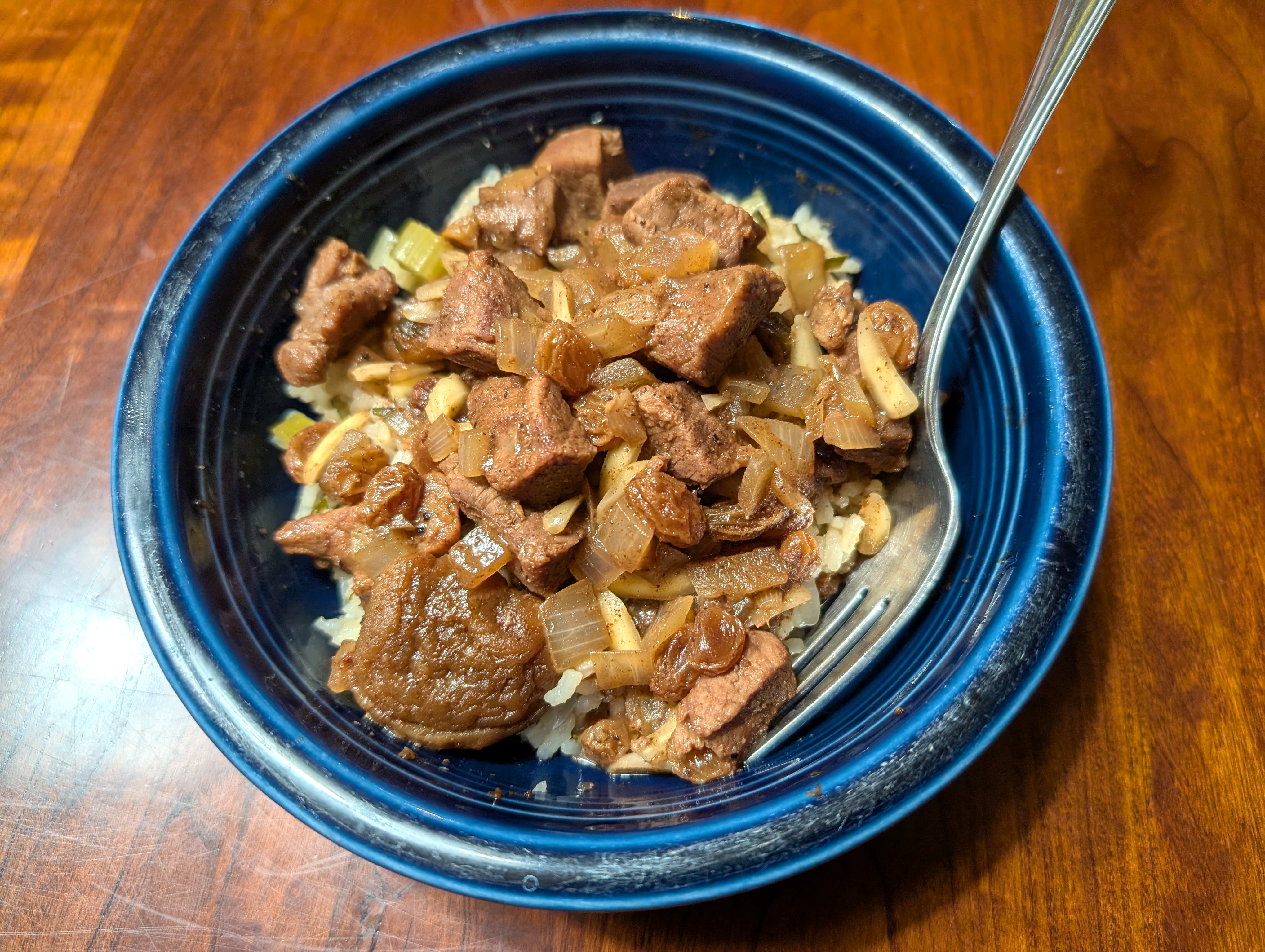
I recently had the opportunity to take a hands-on cooking class on Arabic versus Ottoman versions of a medieval lamb dish, taught by Ellen Perlman. This recipe is a blend of the two different styles, combining the aspects I liked of each one in a way that is probably appropriation but hopefully not too inappropriately so.
Mutajjian is an Arabic word for a dish that is fried in a tagine without the conical lid (i.e., like a ceramic skillet). Tagines are common in North African cuisine, and this is a dish that spread throughout the Muslim world, so it’s understandable that different regions would develop their own variations based on popular themes in the local cuisine. The word tagine itself refers to any dish cooked in a tagine, so mutajjian can similarly be used to described any dish cooked without the lid.
Important tip: If you’re going to cook in a tagine on a modern stove, be sure to use a metal disc or plate between the tagine and the stovetop. This diffuses the heat and protects the ceramic from cracking. There are different kinds of plates for different types of stoves, so be aware of this when you’re shopping for one.
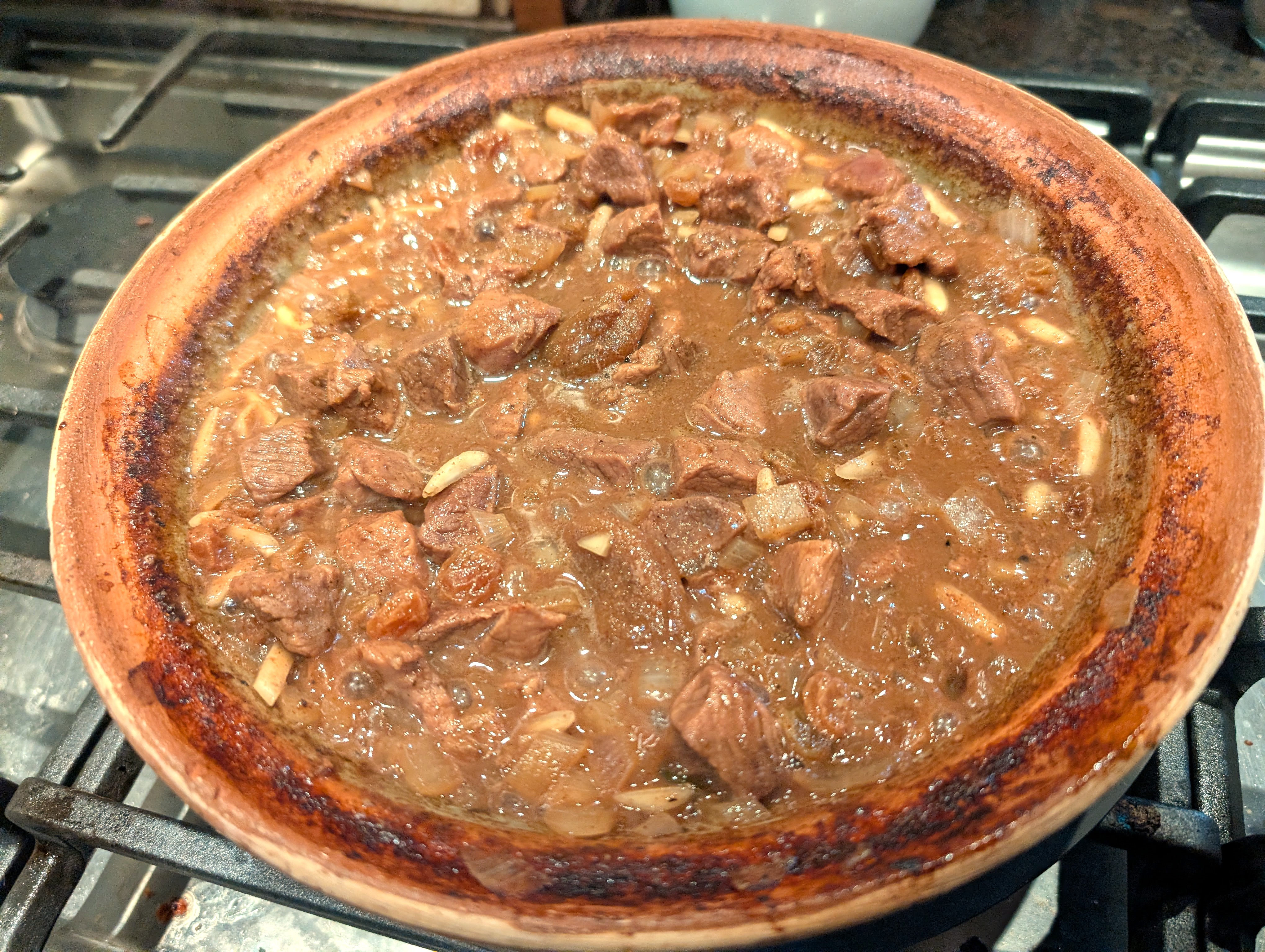
For the purposes of this cooking class, we compared lamb recipes from the 15th-century Ottoman Empire (by Mehmet bin Mahmoud Şirvani, 1430) and an amalgamation of two different Arabic recipes (one by Kitab al-Tabikh al-Baghadi in 1226 and another by the anonymous author of The Book of the Description of Familiar Foods in 1373).
What’s interesting about comparing the versions is that the Ottoman recipe uses fruit, nuts, and honey but no spices (even though they had easy access to the spice trade) — while the Arabic versions used spices, but none of the other stuff found in the Ottoman version. Since I like all of the above, my version is a blend of both, with the spices, fruit, nuts, and honey, because I’m making it for myself and my own tastes.
The combination has a faint sweetness with warming spices. With the fruit and nuts, it vaguely reminds me of something that could be served around the holidays, also reminiscent of European medieval dishes.
Notes on the ingredients: For the wine vinegar, you could use red or white, as long as they aren’t too strong. If you have a bottle or box of wine that’s gone a bit stale, you could use that as it will be mellower than the most common American store-bought vinegars. Wine vinegar helps take some of the gaminess out of lamb in particular.
For the sesame oil, use untoasted. Toasted sesame oil is more of a table seasoning and less for cooking. Lastly, these versions make a big dish, so you might want to cut the recipes in half or more, or cook in batches if you’re using a small tagine.
Onions: The original Turkish version barely cooked the onions because the Ottomans liked their onions to have a little bite. Janissary soldiers in particular were known to eat raw onions.
I cut the recipe below in half since I was just cooking for my spouse and myself. This seemed to be plenty to fill my tagine and we still had leftovers for two, so you might want to consider the size of your tagine before making the full batch.
Anne’s version (cut ingredients in half if using a smaller tagine like mine):
2 1/2 lbs. lamb, cut into bite-sized pieces
water
2 tbsp. murri (OR: 2 tsp. tamari / soy sauce, 2 tsp. Thai fish sauce, 2 tsp. water)
1 tbsp. ground coriander
2 tsp. ground cumin
1 tsp. ground cinnamon
1/2 tsp. ground cardamom
1 tsp. black ground pepper
2 tbsp. honey + more to taste at the end
2 tbsp. butter, clarified butter, ghee, or untoasted sesame oil
3 medium onions, finely chopped
1/2 c. raisins (red or golden)
6 dried apricots
6 dried plums (not prunes; use more apricots if you can’t find them in a store)
~3 tbsp. wine vinegar to taste
1/4 – 1/2 c. almonds or walnuts
Put the meat in a saucepan and cover with water, plus a little more, and bring to a boil, and skim off the foam. Simmer until the meat is cooked.
Remove from the broth, saving both separately.
In a large skillet or tagine base, roast the lamb in the honey and butter until browned. Remove the meat.
Add the broth to the pan and add the onions, raisins, apricots, plums, murri, and spices. Bring to a boil, then reduce to a simmer.
Re-add the meat. When the meat is tender, taste the sauce and add any additional honey and vinegar to taste. It should have some sweeet and sour flavors, but not overwhelmingly so.
Scatter in some nuts and simmer briefly, then serve with naan or rice pilaf.
Arabic version (recipe by Ellen Perlman):
2 1/2 lbs. lamb, cut into bite-sized pieces
water
1 tbsp. wine vinegar
sesame oil as needed
2 tbsp. murri (OR: 2 tsp. tamari or soy sauce, 2 tsp. Thai fish sauce, 2 tsp. water)
1 tbsp. ground coriander
2 tsp. ground cumin
1 tsp. ground cinnamon
1/2 tsp. ground cardamom
lemon juice to taste
Put the meat in a saucepan and cover with water and wine vinegar. Bring it to a boil and boil lightly. Remove the lamb and dry it off. Keep the broth.
In a large skillet or tagine, fry the lamb in sesame oil until cooked and lightly browned.
Re-add the broth and add the murri and spices. Continue to simmer a little longer to bring out the flavors.
Remove from heat. If desired, sprinkle with a little lemon juice before serving.
Ottoman version (recipe by Ellen Perlman):
2 1/2 lbs. lamb, cut into bite-sized pieces
water
2 tsp. salt
1 tsp. black ground pepper
2 tbsp. honey
2 tbsp. butter, clarified butter, or ghee
3 medium onions, finely chopped
1/2 c. red raisins
6 dried apricots
6 dried plums (not prunes; use more apricots if you can’t find them in a store)
honey to taste
3 tbsp. wine vinegar, to taste
1/4 – 1/2 c. almonds or walnuts
Put the meat in a saucepan and cover with water, plus a little more, and bring to a boil, and skim off the foam. Simmer for about 45 minutes until the meat is cooked.
Remove from the broth, saving both separately.
In a large skillet or tagine, roast the lamb in the honey and butter until browned. Remove the meat.
Add the broth to the pan and add the onions, raisins, apricots, and plums. Bring to a boil, then reduce to a simmer.
Re-add the meat. When the meat is tender, add the honey and vinegar so it’s pleasantly sweet and sour, but not too sweet or too sour.
Scatter in some nuts and simmer briefly, then serve.
Sidenote: One interesting bit of trivia I picked up in this class regarded the lack of pork in Islamic cuisine. Sure, it’s banned by the Qur’an, but why? There are often practical reasons behind ancient food restrictions. I expected it to relate to disease, but there are other reasons. For one thing, pigs are the opposite of finicky eaters and will eat garbage, which will affect the taste of the meat if they aren’t kept on a certain diet like pigs on modern farms. For another, pigs as a species apparently don’t do well in arid climates.

