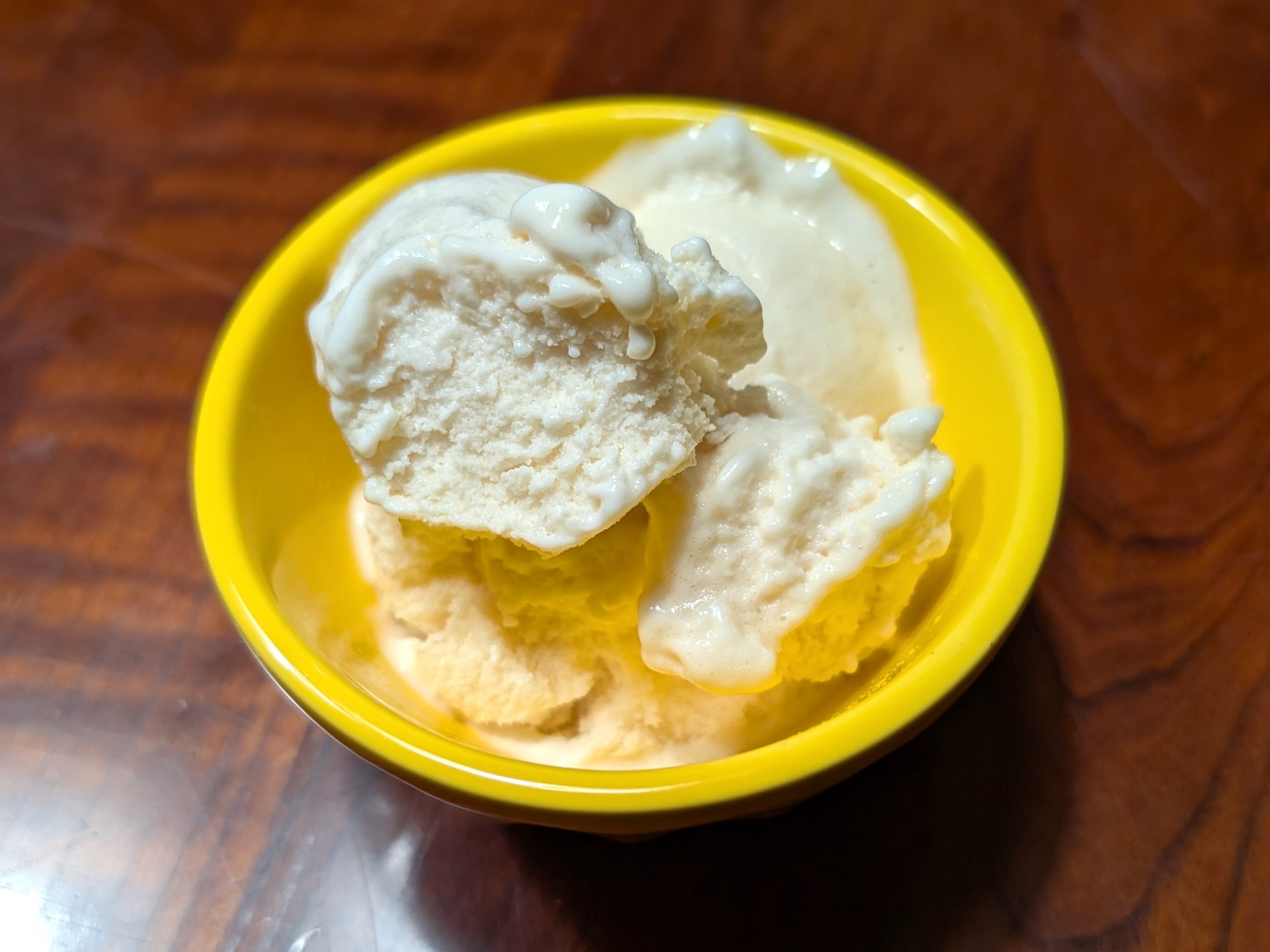
This recipe comes with a moral lesson: ask your elders to walk you through their recipes before it’s too late.
This simple, vanilla ice cream was made at my grandparents’ house on my first birthday. A few years later, I kind of remember going to see my great-aunt Madge and her lifelong “roommate” Ruby’s in Lawrenceville, where they made this ice cream in a cranky old electric ice cream machine in their carport under the solemn gaze of owl-shaped party lights.
Flash forward to 1998, and my mom was determined to send me off to a summer abroad only after she’d made me this ice cream. It was a hellish summer for cicadas that year, and she dutifully watched the ice cream maker running in the driveway while she sat, protected, in the van and occasionally brushed cicadas off the outer hull of the machine with a broom.
Homemade ice cream was always a big treat, and this recipe from my aunt Ruby was my mom’s go-to version when we made it, which unfortunately wasn’t often enough for me to remember the details from my childhood. Stuff goes in a saucepan, something happens, then stuff goes in an old electric ice cream maker that sits outside in 90-degree heat and churns and churns surrounded by ice and rock salt, until it stops because the ice freezes together before it’s finished, and you have to kick it a few times until it starts back up again. The resulting ice cream has the consistency of soft serve when it’s fresh. After it’s gone in the freezer, you’ll need a chisel to get it out of the container.
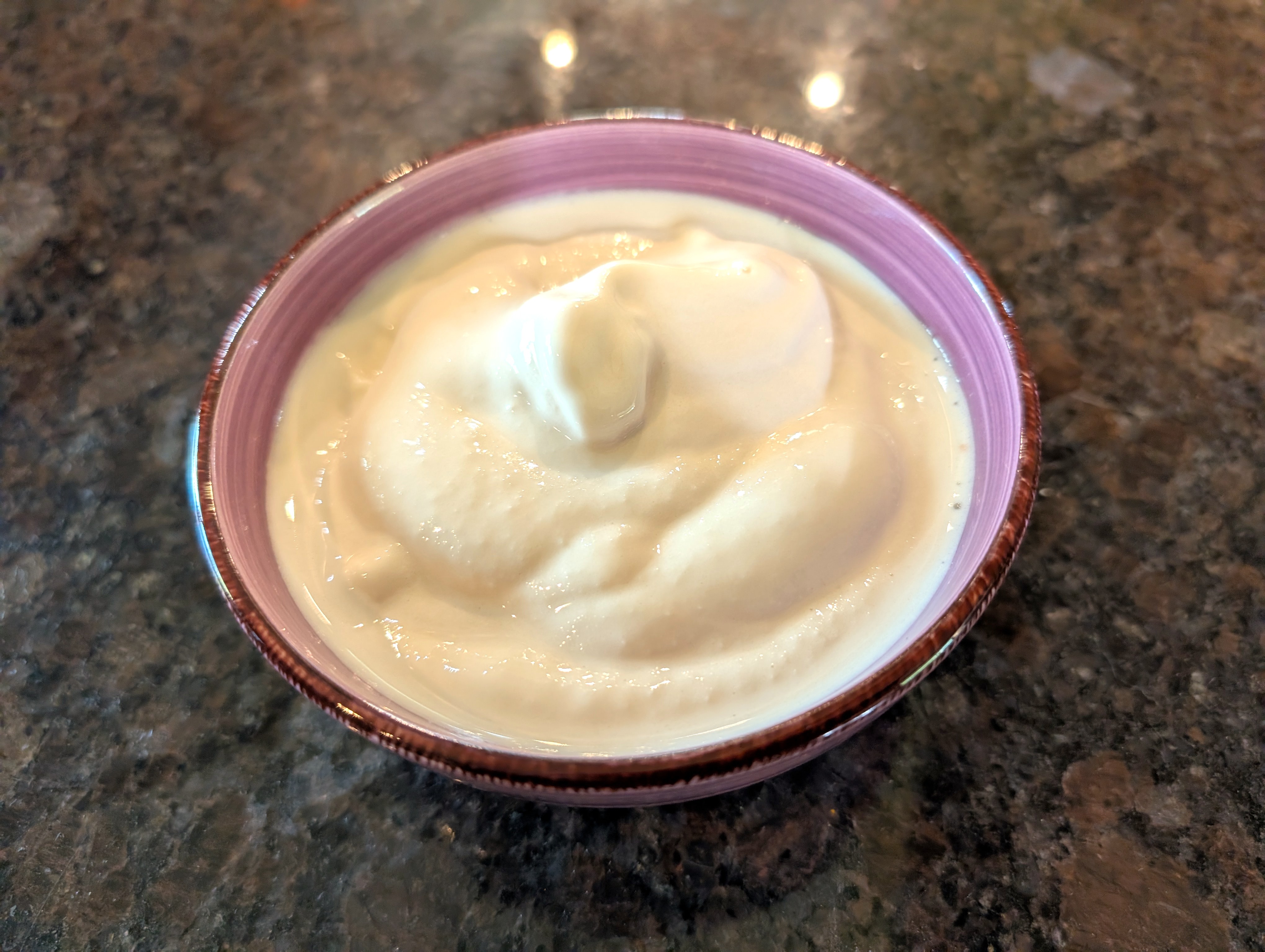
This recipe was likely scribbled down by my mom, while Ruby dictated. (Ruby tended to have the personality of a dictator in her kitchen.) I’ve attempted to recreate her version, though as the written instructions are sparse and contemporary recipes don’t use evaporated milk or gelatin, there are some large margins for error here. What I have below is a sheer guess. I was tempted to leave out the extra cup of boiling water, since I remembered the ice cream getting excessively hard in the freezer and wondered if the the ice to fat ration was imbalanced. I went ahead and added it in this batch, however, since it seems better to learn how to walk before I can run off with experiments.
The result was very soft when I took it out of the ice cream maker, but after a few hours in the freezer it was harder without being too hard to scoop. As such, I’m leaving the extra water in the recipe below. I can’t say what happened with the batches my mom made, but this seems to be working just fine now.
So: while I procrastinated making this recipe because I wasn’t sure I understood the written directions and couldn’t remember enough about it from my childhood, it all seemed to work out. I still stand by my advice above, though — especially if it’s a food you love, make sure you not only get the recipe, but understand the recipe while it’s still possible to ask questions.
A note on the gelatin: This recipe was written down in the 1980s, and because I was worried what 2020s shrinkflation would mean for the amounts, I asked around. A friend pointed me to a conversion in the 1998 edition of Big Kitchen Instruction Book by Rosemary Brown, which indicates that at least at the time, 1 package of gelatin was equal to 1 tablespoon. 1 tablespoon of gelatin powder can equal ~3 standard-sized sheets of leaf gelatin. This will vary depending on the grade of gelatin sheets that you have, so it will be helpful to refer to this conversion chart to determine how many sheets (and how much water for soaking) you’ll need.
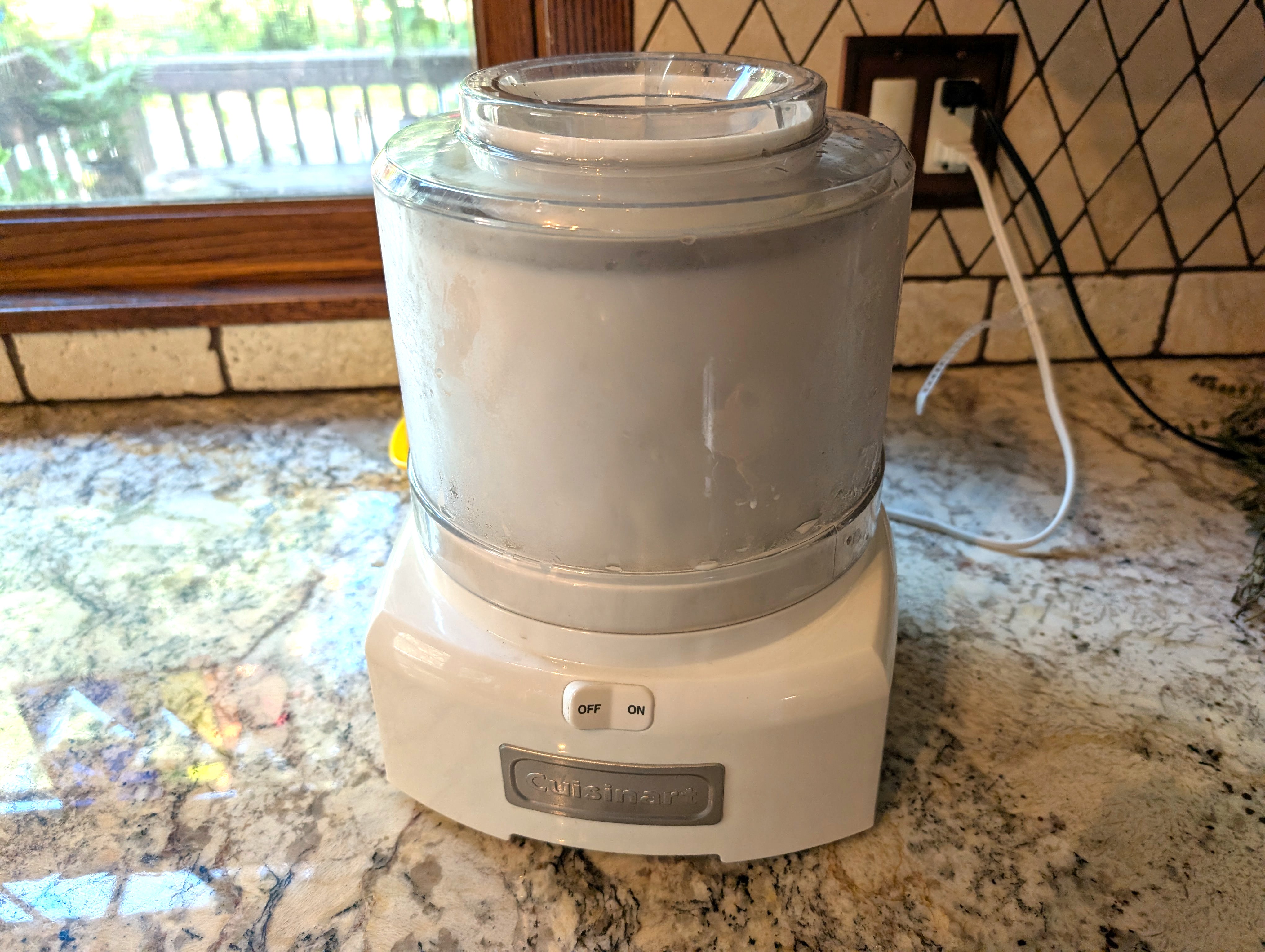
I cut the recipe in half because as much as I have fond memories of this ice cream being made in a large ice cream machine in the driveway, with lots of ice and rock salt, what I currently have is a much smaller ice cream maker that sits on my countertop. I’m actually really grateful that I don’t have to deal with the ice and rock salt (and kicking the machine when it would lock up), to be honest. I did keep the larger-sized amount of vanilla, however, and I think scaling up the vanilla (or other flavor) would be a good move for the larger version.
Alternatives: This makes a basic vanilla ice cream. You can easily switch things up by changing the flavoring to another extract, trying flavored gelatin, and/or adding other spices or ingredients to the mix. I haven’t done this yet, but now that I know how to make the basic recipe work, I might be more inclined to experiment in the future.
Original (large) version: requires a large ice cream machine
3 cans evaporated milk (36 oz.)
1 1/2 cup sugar
1 pint half & half
2 packages of gelatin (2 tbsp. powder) dissolved in 2/3 c. cold water (see note above for sheet conversion)
1 Tablespoon vanilla (consider adding more)
Smaller version: can be made in a countertop ice cream machine and makes ~1 quart
1 1/2 cans evaporated milk (18 oz.)
3/4 c. sugar
1.2 c. half & half
1 package gelatin dissolved in 1/3 c. cold water
1/2 c. boiled water
1 tbsp. vanilla
Mix the gelatin and cold water and set aside.
Boil 1 cup of water, then mix into the gelatin/cold water mix. Let this cool before adding to the dairy mixture below.
Separately, in a large saucepan, heat the evaporated milk, sugar, half and half, and vanilla on medium-high heat, stirring constantly.
Pour in the gelatin water, stirring to keep it from getting lumpy. Remove from heat and let it cool.
Pour the mixture into an ice cream maker and let the contraption do its thing until hopefully you have ice cream. Depending on the size of your ice cream maker, the amount of ice cream might begin to overwhelm the machine and you remove soft serve before the frozen part of the machine gets too warm.
Stick in the freezer for a few hours to harden up the rest of the way.
Original recipe (leave a comment if you understand it differently):
3 cans Carnation evaporated milk (36 oz.)
1 1/2 cup sugar
1 pint half & half
2 packages of gelatin dissolved in cold water
1 cup boiling water: bring to boil again
1 Tablespoon vanilla
Add milk almost full.
Pour in gelatin, stirring so not too lumpy.
Add more milk to fill up.

